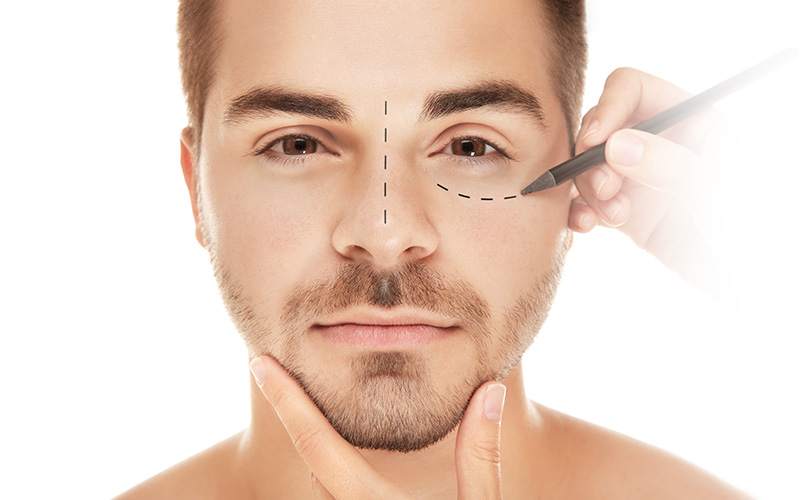
Blepharoplasty is the most popular facial procedure for correcting defects, deformities, and disfigurations of the eyelids. From a young age, eye wrinkles start to develop. These changes in our look usually accelerate as we age depending on an individual’s natural form of expressiveness. In addition, under–eye bags and sagging upper eyelids make the eyes look sad or tired. As a result, the face loses its youthful appearance.
Blepharoplasty surgery not only corrects deformities in that area, but also improves your overall facial appearance, offering a younger, fresher look. Apart from that, a blepharoplasty can also treat functional problems, such as poor vision due to droopy eyelids, inherited syndromes or illnesses.
Ideal candidates are typically men over 40 years old; however, blepharoplasty surgery also applies to younger ages when there are deformities of the eyelids caused either by heredity or disease.
In upper blepharoplasty surgery, an incision is made along the crease of the eyelid while lower blepharoplasty incisions are made directly below the lash line, leaving no visible scar. Incisions are usually made within wrinkles caused by facial expressions (crow’s feet).
However, apart from the traditional technique, there are more approaches that can be implemented depending on the problem.
In younger people with fatty lower eyelids and elastic skin, a transconjunctival blepharoplasty is recommended. The transconjunctival technique utilizes an incision hidden inside the lower eyelid that leaves no visible external scars. Through this incision the surgeon exposes and trims the excess fat.
This approach can be combined with laser resurfacing of the eyelid skin to reduce lines and wrinkles.
There are no complications following blepharoplasty surgery. However, having dry eyes or experiencing difficulty in closing the eyes completely, dryness or increased tear production or a possible delay in the healing process, are expected side effects that gradually subside with the appropriate instructions from your doctor.
On average, blepharoplasty results last for 10-15 years. However, the longevity of the results depend upon several factors including an individual’s genetic background, habits, skin quality, as well as the face’s natural form of expressiveness. Smoking, alcohol consumption and lack of sleep are evaluated as factors affecting the longevity of the results.
We use cookies to improve your experience on our site. By using our site, you consent to cookies.
Manage your cookie preferences below:
Essential cookies enable basic functions and are necessary for the proper function of the website.
These cookies are needed for adding comments on this website.
Google Tag Manager simplifies the management of marketing tags on your website without code changes.
You can find more information in our Cookie Policy and .